
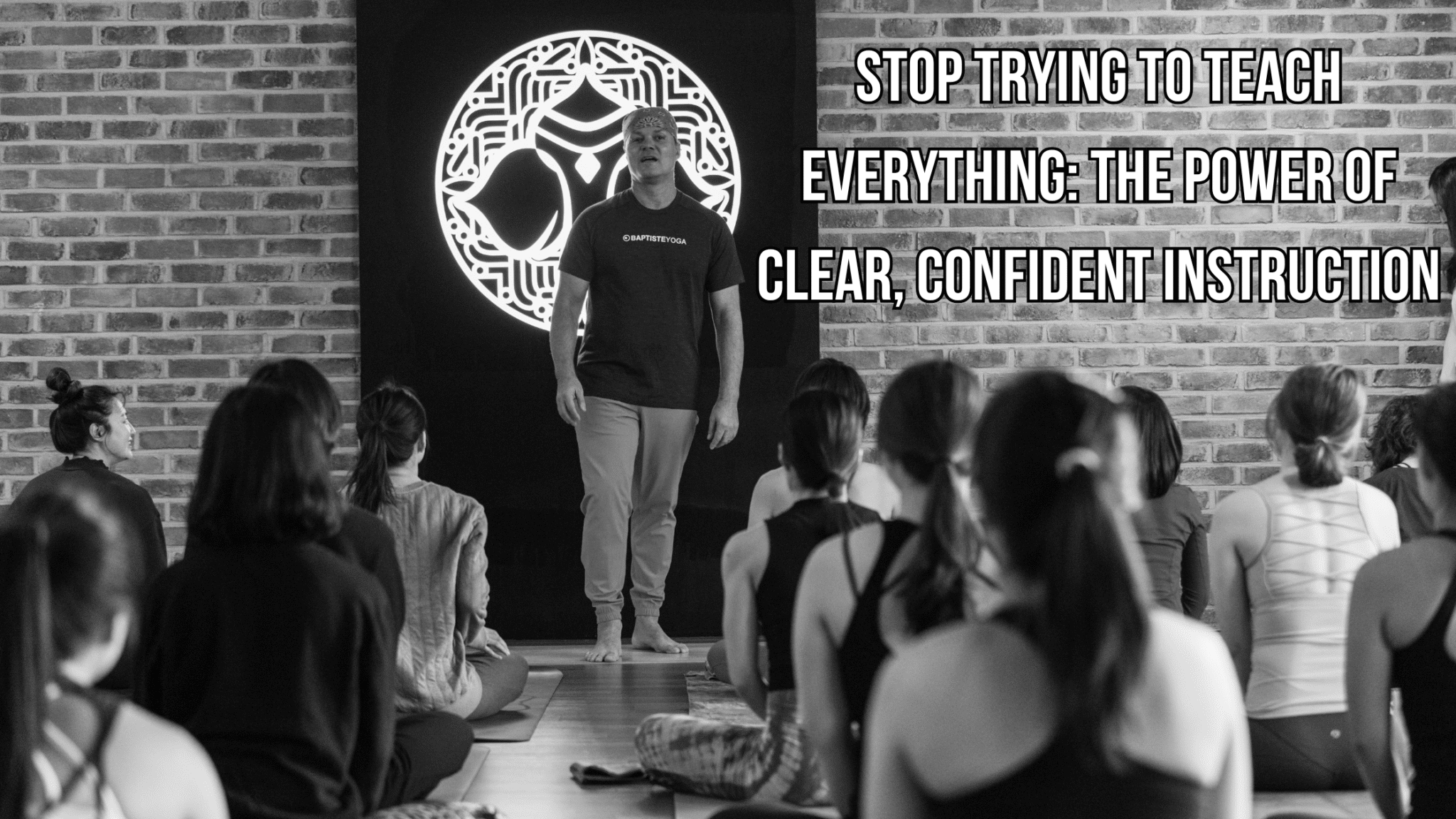
There’s a moment in every teacher’s journey when knowing the material is no longer the challenge.
You know the sequence.
You understand the methodology.
You’ve practiced the poses, studied the principles, and taught enough classes to know that something can look very different from the inside of your own practice than it does from the front of the room.
And then comes the real question:
Can you actually teach it?
Not just demonstrate it.
Not just explain it.
Not just know what comes next.
Can you communicate it clearly enough that your students can experience it for themselves?
That’s where teaching becomes a skill.
More information doesn’t always make you a better teacher
One of the most common traps for developing teachers is believing that better teaching means saying more.
More alignment cues.
More anatomical information.
More explanations.
More options.
More reminders.
More talking.
The intention is usually good. You want your students to understand. You want them to feel supported. You want to make sure nobody misses anything important.
But there is a point where more information creates less clarity.
Students can’t necessarily move better because you gave them five more instructions.
Sometimes they move better because you gave them one clear instruction at the right moment.
Great teaching isn’t about how much you can say.
It’s about whether what you say lands.
Clarity creates confidence
Think about the difference between these two experiences.
A teacher gives a long explanation before a movement. By the time the student hears the final instruction, they’re trying to remember the first three.
Another teacher gives a simple, direct cue. The student understands what to do, has enough space to experience it, and receives the next piece of information when it becomes useful.
The second teacher may actually be saying less.
But they’re teaching more effectively.
Clarity gives students something they can work with.
And clarity comes from the teacher first.
When you are uncertain about what matters most in a moment, your teaching can become cluttered. You fill the space with words because you’re trying to make sure the student gets it.
When you know what matters, you can become more precise.
You can say less.
You can listen more.
You can observe what is actually happening in the room.
And you can respond.
Teaching is not performing
Another shift that happens as teachers develop is realizing that the front of the room isn’t a stage.
Your job isn’t to impress your students with how much you know.
Your job is to create the conditions for them to have an experience.
That requires presence.
Presence means you’re not completely trapped inside the lesson plan. You’re aware of the room. You’re aware of the students. You’re aware of the pace, the energy, and the moment.
You know where you’re going, but you’re also paying attention to what’s happening right now.
That combination—structure and responsiveness—is powerful.
A strong teaching framework gives you something to stand on.
Presence allows you to actually teach the people in front of you.
Give your students room to experience
A useful question to ask yourself after teaching is:
“Did I give my students enough space to experience what I was teaching?”
It’s an easy question to overlook.
As teachers, we can become so focused on delivering the class correctly that we accidentally take over the student’s experience.
We cue.
We explain.
We correct.
We anticipate.
We fill every silence.
But students also need space to practice listening to their own bodies, make adjustments, and discover the experience for themselves.
Sometimes the most effective thing a teacher can do is deliver a clear instruction—and then get out of the way.
Your voice matters
Teaching isn’t only about what you say.
It’s how you say it.
Your pace.
Your tone.
Your timing.
Your confidence.
Your ability to speak without apologizing for the instruction.
Your ability to allow silence without feeling like you have to fill it.
These details shape the experience of the room.
A teacher who is constantly questioning their own instruction can create uncertainty in the students.
A teacher who communicates with clarity and presence creates a different environment.
This doesn’t mean becoming louder, more forceful, or more performative.
Confidence in teaching is not about dominating the room.
It’s about being clear enough to lead it.
A simple practice for your next class
For your next few classes, try this:
Before you teach, choose one thing you want your students to experience clearly.
Then notice how much you actually need to say to support that experience.
During class, challenge yourself to:
Give one clear instruction at a time.
Avoid explaining something that doesn’t need explanation.
Let your cues breathe.
Notice what your students are actually doing.
Use your voice intentionally.
Allow moments of silence.
Trust the framework instead of trying to control every second.
Remember that your students don’t need to hear everything you know.
After class, ask yourself:
Where was I clear?
Where did I over-teach?
Where did I trust my students?
Where could my delivery have been more precise?
These small observations can change the way you teach.
Because becoming a stronger teacher isn’t always about learning something completely new.
Sometimes it’s about refining what you already know until you can transmit it with greater clarity, confidence, and impact.
Knowing the method is different from delivering the method
There is a difference between understanding a teaching methodology and being able to consistently deliver it in a room full of people.
That gap is where teaching skill lives.
It’s the difference between knowing the Journey Into Power sequence and knowing how to conduct it.
It’s knowing the principles and being able to apply them without over-explaining.
It’s developing an instructional voice that feels grounded, clear, and authentic.
It’s learning how to hold space, communicate with precision, and create an experience that keeps students engaged.
And like any skill, it can be practiced.
Ready to refine how you teach?
If you’re ready to go deeper into the craft of teaching, The Teacher’s Edge was created for exactly this.
The Teacher’s Edge is a virtual instructor training focused on instructional mastery—how to skillfully conduct Baptiste Power Yoga classes, apply the methodology with precision, and create powerful, effective classroom experiences.
Taught directly by Baron Baptiste, the training gives you practical frameworks and real-world teaching insights you can apply immediately.
This isn’t about personal transformation.
It’s about how you teach.
You’ll work on clarity, confidence, presence, instructional voice, classroom structure, student engagement, and the practical application of the Baptiste Method.
Whether you’re preparing to become an instructor or you’re already teaching and know there’s another level of precision available to you, The Teacher’s Edge is designed to help close the gap between knowing the method and delivering it powerfully.
Teach with clarity.
Lead with presence.
Deliver the Baptiste Method with confidence and impact.